Hydration guide
How much water should you drink a day?
How much water should you drink a day? The official figures for women and men, why 8 glasses is only a rough guide, and how to find your own target.
Short answer
Most healthy adults need about 2 to 2.5 liters (68 to 85 fl oz) of total water a day in a mild climate, and that figure includes the water in food. The NHS puts it more simply: 6 to 8 glasses of fluid. You need more when you exercise, in hot weather, and during pregnancy or breastfeeding.
Key points
- There is no single number. Body size, activity, climate and health all change it.
- European guidance is 2.0 liters a day for women and 2.5 for men, including the water in food.
- US reference values are higher, at 2.7 and 3.7 liters, with about 20% coming from food.
- "8 glasses a day" is a handy reminder, but a review found no scientific studies behind it.
- Pale yellow urine and rarely feeling thirsty are the simplest signs you are drinking enough.
How much water should you drink a day?
There is no single number that fits everyone. Body size, activity, weather and health all change the answer.
The best starting points come from two expert panels. The European Food Safety Authority (EFSA) sets an adequate intake of 2.0 liters a day for women and 2.5 liters for men, which is about 68 and 85 fl oz. The US National Academies use higher reference values of 2.7 and 3.7 liters, about 91 and 125 fl oz.
Both figures are for total water. That means everything you drink plus the water inside your food. If you prefer glasses to liters, the NHS guide is 6 to 8 cups or glasses of fluid a day.
What do the official guidelines say?
| Source | Women | Men | What it counts |
|---|---|---|---|
| EFSA, Europe (2010) | 2.0 L, about 68 fl oz | 2.5 L, about 85 fl oz | Drinks plus water in food |
| National Academies, US (2004) | 2.7 L, about 91 fl oz | 3.7 L, about 125 fl oz | Drinks plus water in food |
| NHS, UK | 6 to 8 glasses | 6 to 8 glasses | Drinks |
Why the gap between Europe and the US? Neither number is a measured requirement. Both are "adequate intakes", drawn largely from what healthy, well hydrated people were seen to consume. The EFSA values apply to moderate temperatures and moderate activity. The US panel says its values cover healthy, sedentary people in temperate climates.
Harvard's Nutrition Source makes the key point: these amounts are a general guide, not a daily target. A healthy adult who drinks a little less on a given day is not in trouble.
How much of that do you actually have to drink?
Less than the headline figure. The US panel estimates that about 80% of total water comes from drinks and about 20% from food.
Applied to the US values, that leaves roughly 2.2 liters (about 9 cups) of drinks a day for women and 3.0 liters (about 13 cups) for men. Fruit, vegetables, soups and yogurt cover a good part of the rest.
Is the 8 glasses a day rule true?
Partly. Eight 8 oz glasses is about 1.9 liters, close to the European figure for women. As a reminder, it works.
As science, it is shaky. In 2002 the physiologist Heinz Valtin went looking for the evidence behind "8 x 8" and found no scientific studies supporting it. His conclusion applied to healthy adults in a temperate climate with a largely sedentary life. He also noted that caffeinated drinks can count toward the total.
The US panel declined to give any rule in glasses. Its report says the vast majority of healthy people meet their daily needs by letting thirst guide them.
How much water do you need for your weight?
Weight-based formulas are not official guidelines. They are a practical way to personalize a starting number, since a bigger body generally needs more water than a smaller one.
Aquafasty starts from about 35 ml per kg of body weight, roughly half a fluid ounce per pound. It then adds 0.2, 0.4 or 0.7 liters for light, moderate or very active days and keeps the result between 1.5 and 4.5 liters.
| Body weight | 35 ml per kg | On a moderately active day |
|---|---|---|
| 60 kg (132 lb) | 2.1 L, about 71 fl oz | 2.5 L, about 85 fl oz |
| 70 kg (154 lb) | 2.45 L, about 83 fl oz | 2.85 L, about 96 fl oz |
| 80 kg (176 lb) | 2.8 L, about 95 fl oz | 3.2 L, about 108 fl oz |
| 90 kg (198 lb) | 3.15 L, about 107 fl oz | 3.55 L, about 120 fl oz |
Treat the result as a starting point, not a prescription. You can run your own numbers in the water intake calculator.
When do you need more water?
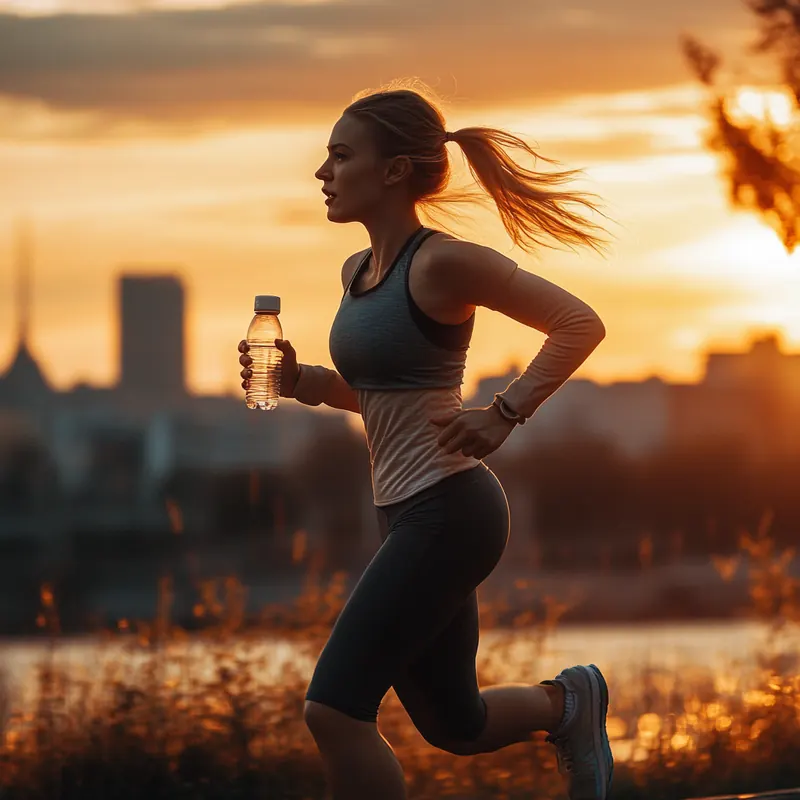
- Exercise. Anything that makes you sweat. Drink before, during and after.
- Heat and humidity. The US panel notes that very active people in hot weather can need 6 liters (about 203 fl oz) or more of total water a day.
- Illness. Fever, vomiting and diarrhea all drain fluid fast.
- Pregnancy and breastfeeding. EFSA adds about 300 ml (10 fl oz) a day in pregnancy and about 700 ml (24 fl oz) a day while breastfeeding.
- Fasting. Food normally supplies part of your water. During a fast that part is missing, so drink on purpose. See can you drink water while fasting.
Does it all have to be plain water?
No. The NHS counts water, lower fat milk and lower sugar drinks, including tea and coffee, toward your daily fluids.
Water is still the best default. It has no calories and no sugar, and it is usually the cheapest thing on the menu. The caffeine question has its own page: does coffee count as water intake.
How do you know if you are drinking enough?
Mayo Clinic gives two simple checks:
- You do not often feel thirsty.
- Your urine is colorless or light yellow.
Dark yellow urine, a dry mouth, headaches or unusual tiredness suggest you are running low. The full list is in signs of dehydration.
Can you drink too much water?
Yes, though it is rare in healthy adults. Drinking far more than your kidneys can clear in a short time can dilute the sodium in your blood. The warning signs are in can you drink too much water.
Free toolWater Intake CalculatorA daily water target from your weight and activity, in liters, glasses and ounces.Open the toolQuestions people ask
How many glasses of water is 2 liters?
Eight glasses of 250 ml make 2 liters. In US cups of 8 fl oz, 2 liters is about eight and a half cups.
Do tea and coffee count toward my daily water intake?
Yes. The NHS counts tea and coffee toward your daily fluids, and the US National Academies concluded that caffeinated drinks contribute to hydration. Keep an eye on total caffeine and on added sugar.
Should I drink a gallon of water a day?
A US gallon is about 3.8 liters. That is more than most people need, since the reference values of 2 to 3.7 liters already include the water in food. If you have a kidney, heart or liver condition, ask your doctor before drinking that much.
Do I need more water when I exercise?
Yes. Sweat is lost fluid, so Mayo Clinic advises drinking water before, during and after a workout. Hot or humid weather raises your needs further.
How much water should I drink while fasting?
Your daily need does not drop when you fast, and you get no water from food during the fasting hours. Aim for your usual target and spread it through the fast. Plain water does not break a fast.
Sources
- Scientific Opinion on Dietary Reference Values for water. EFSA Journal (2010)
- Dietary Reference Intakes for Water, Potassium, Sodium, Chloride, and Sulfate. National Academies Press (2005)
- Report Sets Dietary Intake Levels for Water, Salt, and Potassium. National Academies (2004)
- Water, drinks and hydration. NHS
- "Drink at least eight glasses of water a day." Really? Is there scientific evidence for "8 x 8"? American Journal of Physiology (2002)
- Water: How much should you drink every day? Mayo Clinic (2026)
- Water. The Nutrition Source, Harvard T.H. Chan School of Public Health
Checked against these sources on 21 November 2026. We write "research suggests" where the evidence is still growing. How we write.
Educational information, not medical advice. This page shares general information and does not replace advice from your own doctor. Talk to a doctor before starting any diet or fasting plan, especially if you are pregnant, breastfeeding, under 18, diabetic, on medication or have a history of disordered eating.